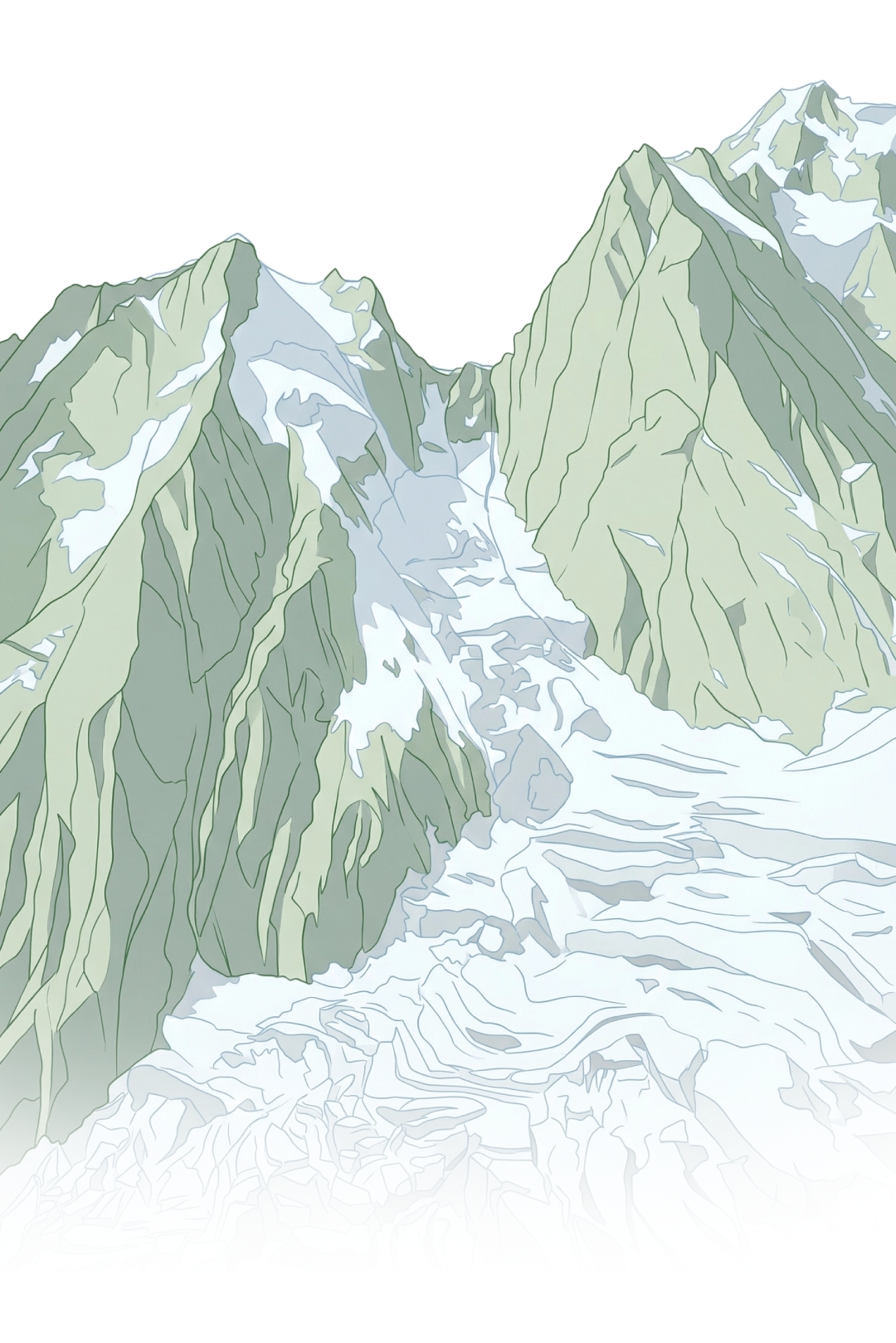
The Brenva is an active glacier: it has a high-altitude accumulation zone that allows it to remain “vital” despite the effects of global warming. Its surface is very rugged and characterized by crevasses, or cracks, and seracs, fragmentation of the glacier into tower-like blocks or pinnacles. This phenomenon is due to the glacier flowing over a steeply sloping rocky bed. For this reason, the Brenva front is subject to frequent collapses.

Stage 13
A living glacier
The Brenva Glacier between crevasses, seracs and rock-ice avalanches
Stage 13“A living glacier”Brenva Glacier Trek
0:000:00
Glacial activity
The Brenva is an active glacier: it has a high-altitude accumulation zone that allows it to remain “vital” despite the effects of global warming. Its surface is very rugged and characterized by crevasses, or cracks, and seracs, fragmentation of the glacier into tower-like blocks or pinnacles. This phenomenon is due to the glacier flowing over a steeply sloping rocky bed. For this reason, the Brenva front is subject to frequent collapses.
Rock-ice avalanche
In the recent history of the Brenva Glacier, there have been several cases of “rock-ice avalanches”, mixed ice and rock avalanches triggered by major landslides. One particularly remembered event is the 1997 rock-ice avalanche, whose blast, made up of an aerosol of snow and dust, rose hundreds of metres up the opposite slope. Rock-ice avalanches have left deep traces in the Brenva moraines, as well as in the collective memory of Courmayeur.